Editor’s note: Want to contribute a guest blog post? Contact us.
By Charles Lincoln
I like three TV shows more than all others. Those are “Buffy the Vampire Slayer,” “Angel,” and “Firefly,” all produced by Joss Whedon. Since I first watched them with my father before I turned ten, these shows have helped me to develop a way of life, an understanding of where I live somewhere between the good and the evil, the living and the dead, the past and the present.
Don’t make fun of me; in the words of the seal of the Order of the Garter: Honi soit qui mal y pense (“Shame on anyone who thinks it bad”). “Buffy,” “Angel,” and “Firefly” teach some very consistent lessons: (1) you never know for sure who your real friends are because (2) you never know for sure what’s true and what’s a lie and (3) for those very reasons, you should always be forgiving and tolerant of others, no matter what they do, because you may need their help someday.
Whedon’s TV philosophy really does teach a great deal about the gray scale, about the gradations between good and evil people and positive and negative actions. “Buffy the Vampire Slayer” was the most popular of these shows, possibly because of the attractive young women who took the lead roles but also because of the consistently-intelligent dialogue and the fact that, unlike so many TV shows and movies, the characters had a certain emotional and social authenticity to them that people could easily (at least for me) relate to.
To my mind, Whedon’s mix of grim realism, humor, and melodrama resembles the style and content of nineteenth and early twentieth-century works such as Charles Dickens’ “Christmas Carol” and Gaston Leroux’s “Phantom of the Opera,” which are also some of my favorite prose writings. The mixture of mystery and horror and music (particularly in the “Buffy” musical “Once More with Feeling” from Season 6) can even be favorably paired with Mozart’s “Magic Flute” or to Shakespeare’s “The Tempest.”
“Angel, a character of immense complexity, parallels Goethe’s Dr. Faustus on the one hand and Mary Shelley’s Dr. Frankenstein on the other in so many, multifaceted, ways. For some reason, I deeply identify with Angel, the vampire/monster, and I dare say that I think he is both a more realistic and a more sympathetic character than either Faust or Frankenstein. Like Faust and Frankenstein, Angel experiments with his own identity and ability to manipulate the world using his special powers; that, I feel, is a projection of human desires. Unlike Faust, Angel suffers a curse, which is the restoration of his soul to atone for his crimes, rather than the damnation of his soul to do so, but “Faustian bargains” (i.e. compromises) are still an everyday part of his life.
By contrast, “Firefly” (and the later “Serenity” film) is devoid of supernatural events or characters and more similar to Dickens’ “A Tale of Two Cities.” There is an interesting, if somewhat tangential, sub-theme in these shows that mind-altering drugs create monsters. The simple truth is that Whedon connects traditional and modern values and problems.
Charles Lincoln is nineteen and currently a college student. He grew up in Austin, Texas. Charles’s first language is English, and he is fluent in Greek and Spanish. His e-mail is c_lincoln (at) rocketmail.com.
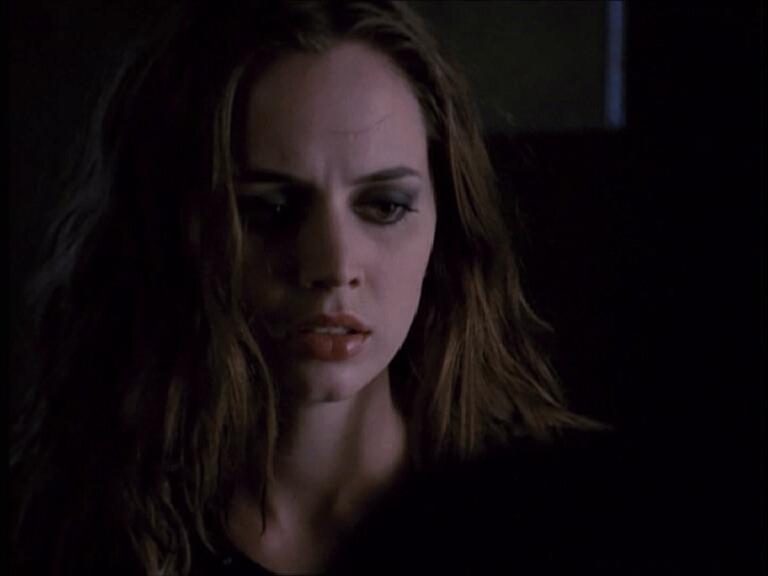
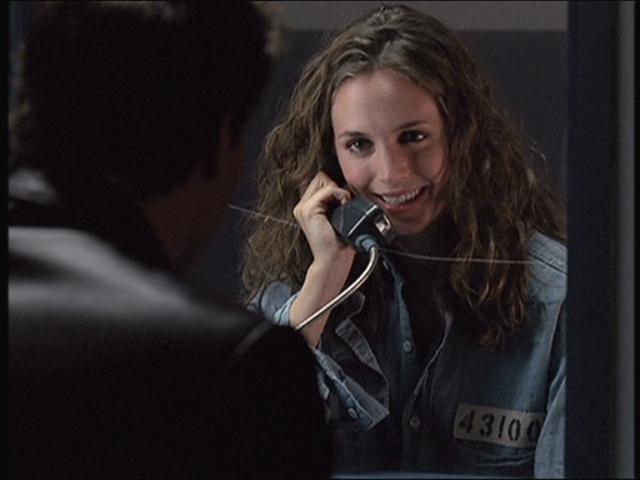
The five stages of grief (known in academics as the Kubler-Ross Model) are fairly well-known, and they have often been used in television dramas within an episode or multiple-episode arc. “Buffy the Vampire Slayer” is no exception. The experiences and action of Faith — a so-called “rogue” vampire slayer who was portrayed by Eliza Dushku — from “Buffy” Season 3 and 4 to “Angel” Season 1 show that creator Joss Whedon, Dushku, and his team of writers surely used the model as the inspiration for the complex character’s change and growth from an off-kilter teenage girl to a mature young woman who voluntarily surrenders herself to the police to atone for her misdeeds over a year.
1. Denial. In the Season 3 episode “Bad Girls,” Faith accidentally kills the deputy mayor of Sunnydale by staking him through the heart. He had seemingly “come of of nowhere” while Faith and Buffy were methodically slaying vampires in assembly-line fashion, one by one. See the episode:
The dialogue between Buffy and Faith demonstrates the latter’s state of denial after the initial shock of her (involuntary) deed. Here are the relevant excerpts:
Buffy: “How are you?”
Faith: “I’m all right. You know me.” (Obviously, Faith is not “all right, and she surely knows that fact.”)
Faith: “There’s nothing to talk about. I was doing my job.”
Buffy: “Sooner or later, we’re both going to have to deal.”
Faith: “Wrong.”
Buffy: “We can help each other.”
Faith: “I don’t need it.”
Buffy: “Faith, you can shut off all the emotions you want, but eventually they’re going to find a body.”
Faith: “… there is no body. I took it, weighted it, and dumped it. Body doesn’t exist.”
Buffy: “Getting rid of the body doesn’t make the problem go away.”
Faith: “It does for me.”
Buffy: “Faith, you don’t get it. You killed a man!”
Faith: “No, you don’t get it. I don’t care.”
2. Anger. In the following episode (“Consequences”), we see Faith entering the second stage of grief over her action — anger — in an increasingly-strong way:
First, Faith makes comments to Buffy that reveal, particularly in her tone of voice, a surge of inherent anger on her part:
Faith: “So, you’re going to rat me out, is that it?”
Buffy: “I can’t pretend to investigate this. I can’t pretend that I don’t know.”
Faith: “Oh, I see. But you can pretend that Angel is still dead when you need to protect him?”
Buffy: “If we don’t do the right thing, it’s only going to make things worse for us… what we did was…”
Faith: “Yeah, we… you were right there beside me when this whole thing went down. Anything I have to answer for, you do to. You’re a part of this, [Buffy], all the way.”
Later, Faith’ makes comments to the detective investigating the killing of the deputy mayor that are as aggressive as they are disrespectful. Then, she tries to get Giles to blame Buffy in a way that combines both her anger and her denial in the early parts of the five stages of grief. See this dialogue between Buffy and Giles afterward:
Giles: “She’s unstable, Buffy. She’s utterly unable to accept responsibility.”
Buffy: “She’s freaking…”
Giles: “She’s in denial. There is no hope for her until she admits what happened.”
Eventually in the same episode, Faith tries to kill Xander after he tries to help her, she attacks Wesley and the other Watchers’ Council members who try to take her away to England, and then she slays Mr. Trick when he and his cohort of vampires attack the two slayers. Faith, of course, eventually joins the mayor in his plot to ascend and become a demon, and all of her violent actions in Seasons 3 and 4 can be sourced to her inner anger at her killing of the deputy mayor.
3. Bargaining. After awaking from her coma in “Buffy” Season 4, temporarily taking over Buffy’s body, sleeping with Buffy’s boyfriend Riley, saving innocent churchgoers from a team of vampires, and then starting to remember her humanity, Faith takes a bus to Los Angeles. The resulting plot is detailed in a two-episode arc in “Angel” Season 1, and the first is “Five by Five”:
Throughout the episode, Faith does actions that can be described as a “murderous calling-card” — she wants Angel to find her, in other words, for reasons that shortly become apparent. She attacks a man near the bus stop, agrees to kill Angel in exchange for money from the evil law-firm Wolfram & Hart, provokes Angel in two initial confrontations involving a crossbow and gun-play, assaults Cordelia, and then kidnaps and tortures Wesley.
Normally, such actions could be described merely as evil deeds done by an evil person. But, in “Five-by-Five,” one scene shows the deeper subtext. After a round of torturing Wesley, Faith sits on a windowsill, playing with a piece of bloody glass, and stares longingly into the empty, night space. Her body language clearly communicates that she wants someone to come and that he has yet to arrive — and that person, as viewers know, is Angel himself.
When Angel does appear, Faith’s immediate response is, “About time, soul boy. Ready to play now (emphasis added)?” She had clearly waited for him. After they begin fighting, Angel tells her in a knowing fashion, “You think I don’t know what you’re after? I do.” Faith seems to gain the upper-hand in the fight and then yells at him, “You can’t take me… no one can take me!” Faith is separating herself from the world and humanity for a reason that is shortly revealed.
However, as the episode reveals, Angel was not fighting to win. Sensing an impending victory, Faith exclaims, “You don’t know what evil is… I’m bad!” She tells him, “Fight back!” Angel responds, “I know what you want, and I’m not going to do it. I’m not going to make it easier on you.”
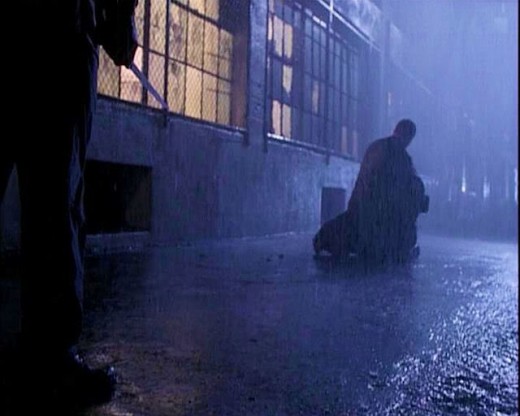
And at this point at the end of the episode, we see Faith finally entering stage three of the grieving process. After starting with denial and anger a television season earlier, she then enters the bargaining phase with this phrase: “I’m evil… I’m bad… do you hear me? I’m bad… Angel, please, just kill me. Just do it…” Faith is bargaining with Angel to kill her to end the pain of her trauma and grieving (and everything she had done in this episode, in my view, was done to provoke him to do exactly that). And then, when he refuses, she collapses in his arms in the rain in the turning-point of her psychological healing:
4. Depression. The final episode of the “Angel” Season 1 two-parter is “Sanctuary,” and it opens with Angel and Faith riding down an elevator at the vampire’s mansion:
Faith is quiet, sullen, and pale. She goes to Angel’s bed, holds herself, and is then wrapped in blankets that the vampire had given her. When Angel tells her, “You rest now; I’ll be close,” she is stoic and does not respond. The following morning, she does take any of the doughnuts offered by Angel, and all she eats later is a bowl of popcorn. (A lack of appetite is a symptom of depression.)
Then, when Faith tries to leave, we see the following dialogue:
Angel: “You go out that door now, you’ll be running for the rest of your life, and my best is, it’ll be a short one.”
Faith: “Doesn’t matter.”
In addition, other comments by Faith reveal her inner depression at all of her actions over the past year:
“Why are you being so nice to me?”
“How do you say, ‘Gee, really sorry that I tortured you nearly to death’?”
“It hurts; I hate that it hurts like this.”
“There’s nothing I can do for you, [Buffy]. I can’t ever make it right.”
5. Acceptance. While dealing with her depression and long-standing grief, Buffy and a team from the Watchers’ Council both arrive in Los Angeles separately, looking for for Faith (for different reasons). The L.A. police department is also searching for her after her earlier assaults and the outstanding warrant from Sunnydale.
After talking with Buffy and hiding from the Watchers’ Council’s assassins, Faith disappears. Then, after the battle has ended, we see later that she is sitting in the police department in handcuffs. With one sentence, Faith finally accepts both what had happened to her and the pain and suffering that she had caused to those who had tried to help her: “I’d like to make a confession.”
At the end of the episode, Wesley tells Angel that he did the right thing in trying to help Faith, who will sit in a jail cell until several seasons later, even after all she had done. (Wesley later helps Faith to escape after Angel turns evil, and then she returns to Sunnydale to help Buffy in Season 7 of that show.) Angel responds:
“I didn’t do it; Faith did… I hope she’s strong enough to make it. Peace is not an easy thing to find.”
Faith’s journey in “Buffy” Season 3 and 4 and “Angel” Season 1 is less about the plot and more about character development. It is a testament to the creativity of Whedon and his team — as well as Dushku’s ability as an actress — that they were able to take a standard plot-device and turn it into something completely original, new, and dramatic over a year spent in Faith’s five-step grieving process.
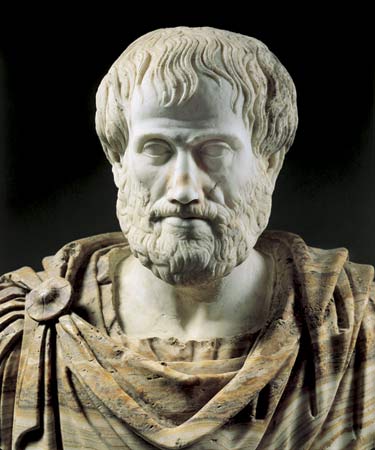
When I was a freshman journalism-major at Boston University in the spring of 1999, one of the required liberal-arts courses was “Introduction to Ethics” since reporters, of course, should strive to be ethical. One of the texts that I have always remembered was Aristotle’s “Nicomachean Ethics,” and Book Three details with the philosopher’s view of “voluntary” and “involuntary” actions and the ethics associated with each. (My professor back then had opened his discussion with, I believe, this rhetorical question: “Am if I kill a man while drunk, was my action ‘voluntary,’ and am I ethically responsible?”)
Recently, I started watching the second and third seasons of “Buffy the Vampire Slayer” again, and I started thinking about these issues while seeing Buffy “kill” Ted and Faith kill the deputy mayor of Sunnydale. In Nicomachean ethical terms, I wondered, were their actions voluntary, and are the two slayers ethically culpable in either or both of the circumstances?
Buffy’s Voluntary and Involuntary Actions
First, of course, we need to define our terms. For the sake of brevity, I will state Aristotle’s discussion of the ethics of “voluntary” and “involuntary” using the following summary from the study notes of Gradesaver (the following are direct statements from the guide, with my few clarifications in brackets):
Involuntary action:
An involuntary action is something done by [outside] force or through [one’s] ignorance
For an action to be involuntary, there must be some external principle causing the action and the person must not contribute anything to the action
Voluntary action:
A voluntary action is one in which the agent of the action knows the particulars on which the action depends
An action performed through temper or desire is still voluntary
Actions concerning the means to an end are in accordance with intention are voluntary
[Individual] actions [that] we are in charge of what we are doing at every step of the way [are voluntary]
Habits are still voluntary because one can choose whether to act or not to act in a certain manner from the outset
Aristotle’s examples of involuntary actions include revealing a secret by accident, misfiring a catapult, or mistakenly giving a person medicine that kills him (actions out of ignorance) or an action in the context of that “the moving principle is outside, being a principle in which nothing is contributed by the person who acts — or rather, is acted upon.” A voluntary action is when “the moving principle is in the agent himself, he being aware of the particular circumstances of the action.” In other words, it is when a person takes direct action and is aware of the causes and effects of the action.
(Of course, there are possible gray areas. An action taking out of anger, desire, or drunkenness — as in my professor’s example — is still, according to Aristotle, “voluntary” because one makes the conscious choice to become drunk or act on his emotions. However, these types of actions are somewhat less “voluntary” than, say, a cold, thought-out plan to purchase a gun and rob a bank.)
In the so-called Buffyverse, there are several examples of involuntary actions:
The most-common example, of course, is a human victim who is turned into a vampire. A girl who makes out with someone who is seemingly human is ignorant of his true nature and what will shortly occur. Moreover, she is primarily being acted upon by an external force rather than directly taking an action herself. In short, she made an ignorant, unintentional mistake. (This could be used in parallel to a discussion on what level of ethical responsibility, if any, a woman has who is partially intimate with a man and is then date-raped.)
When Faith attacked the deputy mayor, a human, and staked him through the heart, she was ignorant that he was human. As the episode reveals, Buffy and Faith were tracking a vampire, and the person suddenly approached them out of nowhere.
And there are many types of voluntary actions (particularly in the two seasons that I am currently watching again):
The mayor of Sunnydale chooses in Season 3 to have demon patrons to ensure a long life (and then an Ascension at the end of Season 3) while being fully aware of the consequences
Xander, in the finale of Season 2, chooses not to tell Buffy, who is on her way to kill the (evil) Angel, that Willow is trying to perform a spell that will restore Angel’s soul — he, we can infer from his comments in prior episodes, wants Buffy to kill him even though there is a chance that Willow’s spell may work
Vampires who attack humans are performing voluntary actions in Aristotle’s eyes because being wicked itself is a voluntary choice (on the part of the demon) rather than just “vampires being vampires” — after all, “Buffy the Vampire Slayer” shows various demons and vampires choosing not to attack humans and living virtuous lives
The Ethics of Buffy’s Actions
A further summary from Gradesaver:
Only voluntary actions can be considered virtuous [or not]
It is unreasonable to think that only good is voluntary while evil is involuntary, for that would contradict our previous conclusion that human beings are the cause of their own actions
A person, according to Aristotle, can only be praised or condemned for a voluntary action on his or her part since people are not responsible — or should not be held responsible — for involuntary actions. In this ethical paradigm, people like Faith are not to be blamed for the death of the deputy mayor and people are not to be held responsible for being turned into vampires (excepting the rare cases we see, like with Buffy’s old high-school friend from Los Angeles in Season 2 (“Lie to Me”), when people actively seek that “change”).
However, we can judge the actions of people in other circumstances that are voluntary. Xander, as most seem to agree, was ethically wrong not to tell Buffy about Willow’s spell, but Buffy’s “killing” of Ted is a situation that is more interesting in an ethical context.
First, a summary of the context. Buffy’s mother is dating Ted, a man whom Buffy dislikes. She even spies on him at work. One night, after disrespecting Ted at dinner, Buffy returns home through the window and sees Ted sitting in her bedroom, reading her diary. He says that she will do whatever he says, or he will show the diary to Buffy’s mother. When Ted starts to leave, Buffy tries to stop him and demands that he return the diary. “Take your hand off me,” he says. “No,” Buffy replies. Ted hits her in the face, hard. “I was so hoping you’d do that,” she responds. Buffy hits Ted, the two begin fighting, and Buffy quickly gains the advantage. She side-kicks Ted multiple times with enough force to push him out through the hallway, and then he falls down the stairs and breaks his neck.
See the episode:
So, would Aristotle say that Buffy’s action was voluntary or involuntary? The answer must be voluntary. The direct action involved (attacking Ted) was a direct choice that Buffy made and not one forced upon her by an outside agent — Aristotle states that actions taken under duress like self-defense or protecting someone else are still voluntary, though somewhat less so, because one still makes an active choice to defend himself while knowing the full context of the situation. In addition, the slayer clearly was not ignorant of the potential results because she must have known that he would be harmed. Buffy’s initial attack on Ted could be viewed as a spontaneous act driven by self-defense — but Aristotle states that such actions are still voluntary while not a matter of conscious choice. (A contrasting point: Buffy’s action could be reviewed as premeditative since she states that she “was so hoping [he’d] do that [emphasis original]” after being hit by Ted — in other words, she had consciously thought about attacking him long before.)
Of course, people who have seen “Buffy the Vampire Slayer” know that Ted was a robot — but neither the characters nor the audience at the time knew this fact until after Buffy’s attack. In the situational context, Buffy believed that she was attacking — and then had killed (directly or not) — a human being. (In legal terms, I believe the case would be a matter of manslaughter and not murder.) So, in a Nicomachean context, was Buffy’s voluntary action ethical?
In simple terms, Aristotle defines “ethical” as the Golden Mean — a point between two unethical ends of a relevant spectrum. The common example cited is that the ethical attribute of “bravery” is the middle ground between “cowardice” and “stupidity.” Cowardice is never fighting at all, even in defense of one’s city (like Sunnydale). Stupidity is rushing into battle against impossible odds while knowing that one will be killed (and all for nothing, as a result).
In the Buffyverse context of the Slayer, the two extremes would be Buffy either never using her superhero strength at all against anyone (for whatever reason) and using her powers against anything and everything (human and demon). (See a prior essay on the nature of authority in “Buffy the Vampire Slayer.”) The Golden Mean, to Aristotle, would still lie somewhere in the middle. In the context of Ted, Buffy moved to far to the latter end of the spectrum when she used her supernatural gifts to harm a human. As a result, Aristotle would say that her voluntary action was unethical.
After all, as Buffy herself says later in the episode: “I had a fight, and I lost my temper… he was a person, and I killed him… I’m the Slayer. I had no right to hit him like that.”
 Editor’s note: Want to contribute a guest blog post? Contact us.